Good Friday - Overlap Of The Ages: Part 3 | April 18, 2025

Transcript
Anyway, hi. With all that said, we're going to start over and I want to welcome you and I just say that we are honored that you would spend part of your Friday evening with us as it's at this Good Friday service as we uh kick off a weekend of uh remembering and celebrating the most important events uh in human history. And um I came across a photo recently and I guess you could say it's a collage of photos. Um and of course each of these individual photos have you know uh people and the stories behind that. As you can see many of them are you know they're playing instruments.
So these are like you know jazz musicians. Uh so each individual uh story has um each picture Thank you Anna. Each individual picture is a person and is a story. And yet uh as a collage, as a collection, what is it that they convey together? What do they communicate? Not as individual pictures, but together. How do we make sense of them? Well, to understand that, we have to zoom back. We have to zoom out. And uh so what this is is a part of a photo mosaic. And this photo mosaic is a picture of the jazz musician Louie Armstrong. So all those individual pictures are now, you know, part of his forehead and they also happen to be people who had uh recorded a session with Louis Armstrong.
So that's kind of like the connection of all the individual pictures. Uh and in the same way as we've gone through our series on the overarching story of the Bible called the Epic of Eden, we've looked at these events and we've looked at these people. And each of these people and events have a meaning in and of themselves. But as you zoom out and you zoom back, we we see that these stories actually collectively point outside of themselves and collectively converge onto the person of Christ. When we zoom out, we see all of these stories have to do with Jesus. As one children's author puts it, every story whispers his name.
And so, uh, to review this story once again, we we to do it, we have a framework of an acronym of the word kingdom. K I N G D O M. And so with K we have kickoff and rebellion talking about creation, fall, the flood, and Babel. With I, we have the instrument of blessing. Talking about Abraham, Isaac, Jacob, and Jacob's sons, the 12 tribes of Israel. With nation redeemed and commissioned, we're talking about the Exodus. We're talking about um Israel's liberation from slavery in Egypt. and as well as the covenant on uh at Cinai and then the wilderness with government in the land. We're talking about the conquest, the judges, the monarchy and the divided kingdom.
But because during this time as they entered the promised land, Israel rebelled against God. They didn't keep the covenant, they worshiped the idols and did the practices of the other nations. So we get to D with dispersion and return talking about the exile. So, go God's people were exiled into Babylon for 70 years before coming back to rebuild a new wall and a new temple. But from there, we get to the New Testament with the letter O. We have overlap of the ages. This is Jesus inaugurating the kingdom of God, bringing the age to come into this present evil age. But we await for all things to be made new.
We wait for new creation when in an era that we can call mission accomplished, new heavens and new earth, God and his people dwelling together again. And so what we did this past Sunday is that we looked at um at least the Old Testament portion of this K through D and saw how each of these stories pointed forward to the person of Jesus. Uh, and tonight we're going to do something similar, except we're going to do so not just talking about Jesus as a whole, but rather talking about specifically the death of Jesus. How is it that these events and stories from the Hebrew scriptures point forward specifically to uh the death of Jesus?
Except tonight um the difference is tonight I'm going to actually do this backwards. Um I'm going to start with D and work my way to K one for a change of pace. Uh but second, I want to end uh thinking about how the cross what it has to do with our origin story and what it has to do with our root uh problems as human beings. So going backwards, it's it's like this sermon is directed by the movie director Christopher Nolan. That reference has a limited audience, but I did it anyway. Um I'll move forward now. Uh we start with D, dispersion and return. talking about the exile.
What does the crucifixion of Jesus have to do with the exile? Well, in Galatians chapter 3, Paul writes, "For all who rely on the works of the law are under a curse, as it is written, curses everyone who does not contribute does not continue to do everything written in the book of the law." So when Paul writes, "It is written," we have to ask ourselves, okay, where is it written? And it's going to be something from the Hebrew scriptures. So we look back and we find in Deuteronomy 27 26, cursed is anyone who does not uphold the words of the law by carrying them out.
The next chapter in Deuteronomy 28, we got we start to get more specific about these about these curses in uh 28:15. However, if you do not obey the Lord your God and do not carefully follow all his commandments and decrees I'm giving you today, all these curses will come upon you and overtake you. So, it's kind of like if you think back to Genesis 1 or rather Genesis 2 in the garden, uh God instructs humanity about a certain tree. Don't eat of this one tree. And what this tree is about, uh it is a test. It it's about the question, will humanity allow God to define what is good or will they themselves seek to redefine what is good and evil?
Will they seek to do what is right in their own eyes? And in the same way in Deuteronomy, it's kind of like this moment in Genesis 2 where God's saying like, "Look, I'm giving you options, blessing or curse, life and death. Do you want a Genesis 1 and 2 kind of life or do you want a Genesis 3 to1 kind of life?" So, be faithful to the covenant. And it's not as though if they messed up once that God was going to completely come down and, you know, uh, bring the curses on them. God knew that they weren't going to perfectly keep this covenant. That's why he instituted the sacrificial system.
When you get things wrong, there's a sacrificial system. You come and repent and you come to me and we'll and we'll go from there. But if you just consistently ignore all of this over time, these curses will overtake you. In 28, he lists some of these curses. One of those curses in chapter 36, we read, "The Lord will drive you and the king you set over you to a nation unknown to you or your ancestors. And we see that's how the Old Testament unfolds as Israel goes into exile and Babylon. They weren't faithful to the covenant. And so this curse overtook them. But moving forward back to Galatians 3 and verse 13, Paul writes, "Christ redeemed us from the curse of the law by becoming a curse for us.
For it is written, cursed is everyone who is hung on a tree." And so all these curses we we talk about in Deuteronomy 28, there's a sense that those curses have now been taken on by Christ, including the curse of exile. Jesus on the cross experienced alienation, experienced exile, even though he was the obedient Israelite, even though he was the one Israelite faithful to the covenant, he took those curses upon himself. He endured the curse of exile so that we could have the blessing of being brought home so that we could have a way back to the garden. So in that way we can connect the story of exile to the crucifixion of Jesus.
But going up in the list moving on to government in the land we see in Matthew chapter 27 as Jesus hangs on the cross in verse 45 from noon until 3 in the afternoon darkness came over all the land. About 3 in the afternoon, Jesus cried out in a loud voice, Eli Eli lema sabakani, which means my God, my God, why have you forsaken me? How do we make sense out of this utterance of Jesus here? Is he is he giving up on the plan or does he think that God has given up on the plan? Is he somehow suddenly is is he shaken? Has he lost his nerve?
Does he think that, you know, um, is he caught off guard? I'm not sure that he's caught off guard because multiple times he tells his disciples, "The son of man will go into Jerusalem. He'll be foggged, handed over to the Gentiles, and crucified." He's not caught off guard. But what so what's going on here is Jesus says, "Why have you forsaken me?" And certainly there was an extreme element of suffering that Jesus was experiencing. And he was experiencing something certainly that would have felt like God forsakenness. But I wonder if there's something more here. So there's questions here. And the other question of course is, you know, if I'm labeling this under government in the land, what does this moment here have to do with government in the land?
Well, it's hard to talk about the uh era of government in the land within redemptive history without talking about King David. And of course, King David was king, but he was also a poet. He wrote the song book of Israel, at least part of it. And in Psalm 22 verse one, he writes, "My God, my God, why have you forsaken me? Why are you so far from saving me? so far from my cries of anguish. So we see this phrase did not originate with Jesus within this moment, but there's a broader context of it. D Jesus is using David's own words, but it seems that we want to continue investigating what else does David write in Psalm 22.
Here's a few ex samples of that. In verse seven and 8, David writes, "All who see me mock me. They herald insults, shaking their heads. He trusts in the Lord, they say. Let the Lord rescue him. Let him deliver him since he delights in him. In verse 16, dogs surround me. A pack of villains encircle me. They pierce my hands and my feet. And then in verse 18, they divide my clothes among themselves. They cast lots for my garment. Now, let's take all of this into consideration and zoom forward to Matthew chapter 27. Let's keep in mind, why have you forsaken me? They see me.
They mock me. He trusts in God. They've pierced my hands and my feet and they're gambling for my clothes. Keep those things in mind as we go ahead to Matthew 27 where in verse 35 it says, "When they had crucified him, they divided up his clothes by casting lots." Here we address two parts of Psalm 22 with one verse. first and they crucified him. Matthew doesn't go into detail about what that means because he assumed his audience knew what it meant for someone to be crucified. It means they had put nails through his hands and through his feet. But also as this happened, they divided up his clothes and were casting lots there at the foot of the cross.
Roman soldiers were gambling for Jesus's clothes. But going on from there in verse 39, those who passed by hurled insults at him, shaking their heads. I mean, they were saying, "He's saved others, but he can't save himself." So, they were mocking him. Verse 43 says, "He trusts in God. Let God rescue him now if he wants him, for he said, I am the son of God." Any of that sound familiar? It all points back to Psalm 22. So as this is going on, Jesus recognizes that his hands and feet are pierced. He recognizes people are gambling for his clothes. He sees that people mocking him and saying he trusts in God.
And what comes to Jesus's mind is this psalm where David says, "Why have you forsaken me?" In other words, Jesus is saying this is Psalm 22. Of course, Jesus would not have put though put it in those terms because uh chapters and verses were not divided numerically in those days. That didn't happen until the middle ages. And so in those days when a rabbi wanted to reference a passage of scripture, he would give the opening line and expect you to fill in the blanks and expect you to to recognize what he was talking about within that block. So if I were to say to you, "Oh, say can you see?" you're going to think of the content of the entire national anthem.
So for Jesus to say, "My God, my God, why have you forsaken me?" He's saying, "Guys, this is Psalm 22." But we have to consider what else is in Psalm 22. Because the thing about the Psalms, as a scholar named Walter Bugamman talks about is that the Psalms often have this sense of orientation, disorientation, and reorientation. There are sometimes when the psalmist is disoriented. God, where are you? God, are you hearing my cries? But then there's a reorientation where there's faith and there's trust. And in Psalm 22, the very psalm that starts with, "My God, why have you forsaken me?" also says, "I will declare your name to my people.
In the assembly, I will praise you. You who fear the Lord, praise him. All you descendants of Jacob, honor him. Rever him, you descendants of Israel. For he has not despised or scorned the suffering of the afflicted one. He has not hidden his face from him but has listened to his cry for help. So in Jesus's cry of despair was an expression of his trust in God. Acknowledging the moment with the very scriptures inspired by God. And we can think of it this way. Jesus cried out, "Why have you forsaken me?" so that you and I would never have to. But as we move up into the story from government in the land to nation, redeemed and commissioned, we remember that on the night that Jesus was arrest betrayed and arrested earlier that night, he was having a Passover meal with his disciples and in a sense giving it new meaning.
But they were there celebrating something in their history that happened hundreds of years before with the liberation of their people from slavery. And in a sense tonight, we are also celebrating something that happened in our history. Something that shapes and forms our identity. Well, that's what they were doing. For they were celebrating a Passover, the time during the Exodus, where God told Israel to, you know, uh, I was I'm going to bring about the last plague. And through this plague, the death of the firstborn in all the land, I'm going to loosen Pharaoh's grip on you to redeem you from slavery. But what you are to do is that you are to take a lamb unblenmished a year old and take its blood, paint it on your doorframes there where I will pass over your house because essentially something there has already died.
But then we see in Exodus 3:31 during that night Pharaoh summoned Moses and Aaron and said up leave my people you and the Israelites go worship the Lord if you were requested. take my your flocks and herds as you have said and also bless me. So through the Passover and through the blood of the Passover lamb, Israel was redeemed and rescued from slavery and from death. And in the same way that the New Testament, you know, picks up on this as John the Baptist calls out, perhaps this is what he had in mind when he said, "Behold the lamb of God who takes away the sins of the world." But of course, of course, Paul is a bit more precise when he says in 1 Corinthians 5:7, "Christ, our Passover lamb has been sacrificed." He's our Passover lamb who redeems us and liberates us from slavery to sin and death.
And we can think about it this way as well with um with crucifixion. It's it was such a horrible thing, such a horrible way to die. Um you know, and it was invented by the Persians, perfected by the Romans. Uh it didn't exist back in David's day. So when he said, "They pierce my hands and my feet," something else is going on there. But um but and it's interesting. I was in a store the other day and I saw um they were selling chocolate crosses and uh I don't want anyone to feel guilty if you have a chocolate cross. I just think it's interesting that what other execution device do we make candy out of?
Here we have licorice guillotines and you know like chocolate nooes, right? What else do we do that with? But it seems that Christ has you know really completely turned what the cross means completely in a different direction. But in the Roman Empire, uh, it was such a horrible death that Roman citizens were exempt from it. But it was a death reserved for rebels, those who committed treason against the emperor and the empire. As well as it was the death reserved for slaves. And so we can think of it this way. Jesus died the death of slaves and rebels in order to set slaves and rebels free.
He died the death that we invited because of our treason. Moving up again to instrument of blessing, the era of the patriarchs. I would argue that the climax of this era in redemptive history is in Genesis 22 after God had finally blessed Abraham at age 100 with a son, Isaac. The son grew up a bit. But then in Genesis 22, God said to Abraham, "Take your son, your only son whom you love, Isaac, and go to the region of Moria. Sacrifice him there as a burnt offering on a mountain. I will show you." This is a shock for any of us to read. It's a shocking request, but I would say that we can't read the story of Abraham and Isaac in isolation.
We have to understand it in light of the whole story of Abraham because Abraham was a man of faith and in many regards his faith was counted to him as righteousness. However, Abraham didn't always get it right. There were times where he manipulated things and he was dishonest. things that he did things his own way, showing that he wasn't always in complete trust of God. But yet here, finally, now that God has given Abraham the son that he has promised to him, will he finally trust God? Now, we could think to ourselves like, well, God's omnisient. He knows everything. Doesn't he already know whether or not Abraham trusts him?
Sometimes faith needs to be more than theoretical. It needs to be lived out. It needs to be expressed. It needs to be experienced. Abraham as the father of a nation that was meant to be faithful to God needed to go through this process, a completion of faith. And so Abraham takes his son Isaac on a three-day journey to the land of Mariah. I think I said Moria earlier. That's probably a Lord of the Rings reference. I'm gonna Someone caught me there. Yeah. the land of Moriah. Um, and he, you know, the Isaac carries the wood up the mountain and he has the question on his mind.
Hey, Dad, where's the lamb for the sacrifice? Abraham says, well, the Lord will provide. As he grips his knife, the Lord says, "Stop, Abraham. Don't lay a hand on a boy. Don't harm him. For now I know you fear God. For you have not kept your son, your only son, from me." And so Abraham looks up and sees a ram caught by his horns in a thicket. And it becomes the sacrifice. It becomes the substitute for Isaac's sake. Now the author of Hebrews in Hebrews chapter 11 and verse 17. Now Abraham when he was tested offered up Isaac whom he had received the promises and was in the act of offering up his only son of whom it was said through Isaac shall your offspring be named.
He considered that God was even able to raise him from the dead. And I'm I'm I'm certain that the parallels are pretty obvious carrying wood up the mountain was the beloved son about to be offered by the father. So we can say it this way is that Jesus is Isaac and yet so are we because Jesus is is Isaac in terms that he's the beloved son and yet he's also the ram the substitution the substitutionary sacrifice. He is the lamb that God provided. So in a sense we are Isaac because we didn't have to die but we can be received by the father because of our substitute.
And as a result of this, just as God said to Abraham, "Now I know you fear God because you have not withheld from me your son, your only son." We in turn can say to God, "Now I know you love me because you have not with withheld from me your son, your only son." For as Romans 8 says, he did not spare his son, but gave him up for us all. finally ending at K kickoff in rebellion. We're pretty well acquainted with the story of creation and the fall. But after humanity does what is right in their own eyes, after they choose to redefine good and evil for themselves, we see the consequences of that in Genesis 3:7, we have nakedness and shame.
Humanity was already naked, but now they because of sin, they they knew it. And there was shame involved. They tried to cover themselves with fig leaves. And then in Genesis 3:28, God says to Adam, "Curses the ground because of you. In pain you shall eat of it all the days of your life. Thorns and thistles it shall produce for you." And he says, "You'll go on and do this until you are dust because you are dust and to dust you shall return." He announces the consequence of death in 3:19. And of course moving forward thinking about Jesus we see how he overcomes and takes on each of these curses.
The curse of nakedness and shame. You know most of the paintings throughout the centuries have depicted Jesus hanging on the cross with a bit of a loin cloth out of out of modesty. But the reality is the historical reality is that Jesus was hanging there naked on the cross. Because crucifixion wasn't only about pain and torture. It was about shame. It was a warning shot to anyone. This is not how you want to die. Not only because of pain, but because of shame. So victims were crucified naked. So just as Adam and Eve as they were evicted from the garden, God replaces their fig leaves with the skin of an animal.
Because in order to adequately cover humanity's nakedness and shame, something has to die. And on the cross, Jesus overcame the curse of Adam's nakedness and shame by bearing that curse himself. Oh, of course, Jesus was given one thing to wear. The Roman soldiers hearing that his claim to be king of the Jews twisted together a crown of thorns so that he could wear it. The very thing that the ground was cursed because of sin with thorns, Jesus bore that curse upon his head. And of course, he went through the curse of death as well. But that's not the only way that Genesis 3 points forward to this moment in history.
We see God speak to the man as well as the woman. But before he does any of that, he speaks to the serpent, this spiritual evil who tempts and deceives humanity by saying in 3:15, "I will put enmity between you and the woman, between your offspring and hers. He will crush your head and he will strike your heel. And throughout the story of the scriptures, we wonder how this is going to unfold. Who's going to be the offspring of the woman to defeat evil once and for all to take us back to the garden. But then Colossians 2:14 says, "By cancelelling the record of debt that stood against us with its legal demands, this he set aside, nailing it to the cross.
He disarmed the rulers and authorities, spiritual evil, and put them to open shame, triumphing over them in him. As it says in Hebrews 2:14, he too, Jesus, shared in their humanity, so that by his death, he might break the power of him who holds the power of death, that is the devil, and free those who all their lives were held in slavery by the fear of death. So Genesis 3 points forward to the crucifixion of Jesus by that being the very moment he overcomes evil. What looked like Jesus's defeat was the means of his victory. As the nail was leaving a wound in his heel, he was going through the process of crushing the head of the serpent.
So in review and and we could say in summary this time going forward that with kickoff and rebellion Jesus took the curse of Adam's nakedness, shame, thorns and death while becoming the snake crushing seed of the woman with instrument of blessing. Jesus is the beloved son offered by the father as well as the provided substitutionary sacrifice with nation redeemed and commissioned. Jesus is the Passover lamb whose blood makes possible his people's exodus from slavery and death. With government in the land, Jesus sang worship lyrics from David. Why have you forsaken me? So that we will never have to. And with dispersion in return, Jesus took the curse of exile to bless us with the way home and back to the garden.
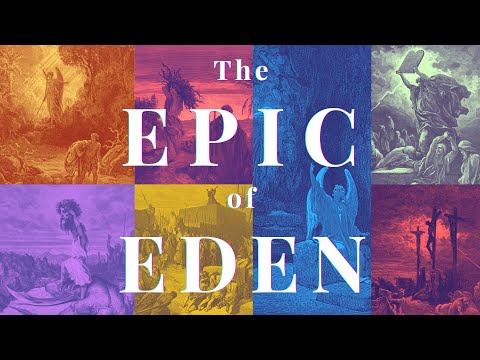
Over and over and over, the story of the Hebrew scriptures is pointing forward to the moment that we recognize tonight. And I think perhaps this is a reason that we can believe that this is true. Who could orchestrate such a story over centuries that converge onto one point so compellingly? Some of the um the artwork that we've had with the the sermon slide associated with this series uh comes from an artist named Gustaf Dory. Um and so he skillfully depicted many you know biblical scenes such as you know the uh the exile from the garden and then over to the to the right the tower of babel and then uh Moses giving the commandments, David holding the head of Goliath.
That's a huge head he's got there. uh Abraham and Isaac and then the re beginning of the rebuilding of the temple. And so like we did earlier looking at a collection of these pictures individually they tell a story. Individually they have a meaning of their own but when you take them as a collection and you zoom out all together we have a picture of what it's all about. Picture of the one who would fulfill all of these stories. and reveal their purpose. So as we end and as the band uh comes up, I want us to think about how the cross meets us in the daytoday um of life because yes, thankfully by the cross we know that by believing in Jesus that he has taken our sin and buried it and that through him we can be forgiven.
We can be reconciled to God. We can be adopted. We have assurance of salvation. That is great news. And that is news that we can, you know, hold on to as hope every day. But other ways that we can apply the cross, I think we're helped by a pastor named Tim Chester. Uh Tim Chester gives what he calls the four G's. And and each of these G's uh is uh a one of the um uh I guess an attribute of God, a characteristic of God. H but he also gives us an implication of that for our life. Um and so I would say that these attributes of God are displayed greatly at the cross.
So for example, God is gracious so I don't have to prove myself. We're often trying to prove oursel. In fact outside of the gospel, every world religion is based upon proving ourselves and earning earning favor from God. But because God shows his grace, his unmmerited favor by Jesus's death on our behalf on the cross, God is that gracious, I don't have to prove myself. Now, obedience is important, but obedience is not for the the sake of earning God's grace. Obedience is the result of receiving God's grace that he shines a light on through the cross. Next, God is great, so I don't have to be in control.
As God orchestrates this story, you know, he shows his uh power and his wisdom orchestrating this story over millennia for your salvation. How great is that? How brilliant is that? Think about this. Is that the kind of being that needs your advice? If we see how God can brilliantly orchestrate salvation, we know that he's the not the kind of guy who needs us to tell him how things should be going. And so therefore, if he can take all of this that happened in human history, and bring it about for your salvation, our salvation, we can conclude that he knows what he's doing. and that whatever situation that we find ourselves in, we can have a big picture view of it and trust that he knows what he's doing.
Because he's great, I don't have to be in control. Next, because God is glorious, I don't have to fear others. God displays his glory on the cross by snatching victory from the jaws of defeat. That's glorious. We often attribute weight or gravitas to other people and we revere them and we want their approval. But because the cross through the cross we already have God's approval and when we hold God's glory compare it to the glory that we kind of like think that other people have those people don't compare. And the fact that you already have God's approval, you don't need their approval because God is glorious.
And finally, because God is good, I don't have to look elsewhere. I don't have to look elsewhere for goodness. I don't have to look elsewhere for for forgiveness or for joy or for satisfaction or for love because on the cross, God displays his goodness. Where else will you find that kind of love? You don't have to look elsewhere because God is good. And so God says to us, "Taste and see that the Lord is good." and we're about to do just that. So, if the communion team will go ahead and come tonight, we're going to partake of the Lord's table. As on a Passover meal, Jesus took bread.
He took Passover bread which is unleavened. It is bruised, striped, and pierced. And he gives it new meaning, saying, "This is my body broken for you. Eat this in remembrance of me." And just as God told Adam, "By the sweat of your brow, by your toil, you will eat bread." It was by the work by the toil of Jesus that he became bread for us to save us and satisfy us. And then Jesus raised the cup, saying, "This cup is the new covenant in my blood." Unlike the old covenant, the blood of bull is sprinkled on the people, this is something within the new covenant we take into ourselves as God writes his law on our hearts and through the spirit we can obey him.
So as you come at your own initiative, you'll take a piece of bread. You'll be told, "Remember the body of Christ broken for you." You'll dip it into the cup. We'll be reminded this is the blood of Christ shed for you. So as we do this aresh, as we do this again, let's remember the God who is gracious, great, glorious, and good. Our father, as we ask this question of such a dark day, how can we call it Good Friday? It's because the character of the one who completed the work. We are not good, but you are good and you make us good. And so tonight, as we remember your good story, as we remember how you have orchestrated all this amazing history to point to your son and to his work on the cross, as well as through his resurrection from the dead, he is the key that unlocks all of it.
He is the plot twist through which we make sense of the story. So God, may it be true that through him, we also make sense of our own story as we remember tonight the forgiveness, the the amount of love, the the the sacrifice that he made so that we again could be with you. Let us never take that for granted. As familiar as that could be, let us never become bored with it. but help us to always hear it with fresh ears and always delight in it as good news. In Jesus name we ask these things. Amen. If you would um want to uh come up to your section uh from the aisle to the right and then go back down to your section from the aisle to your left.
Uh that would keep things somewhat organized. So when as the band plays uh you come at your own [Music] [Music] initiative stood an old rugged cross the suffering and shame. And I love that old cross where the dearest and best for a world of sinners was slain. [Music] Oh, that old rugged cross by the world has action for me. For the dear lamb of God left his glory above to bear it to dark Calary. So I'll cherish the old rugged cross till my trophies at last I lay down. I will cling to the old ragged cross and exchange it for a crown. [Music] to the old rugged cross will ever be true.
It's shame and reproach gladly. Then he'll call me someday to my home far away where his glory forever I'll share. So I'll cherish the old rugged cross till my trophies at last I lay down. I will cling to the old rugged cross and exchange it someday for a crown. I will cling to the old ruged cross and exchange it for a cross. [Music] Well, we look forward to celebrating the other side of the story on Sunday. And you guys can have a seat real quick. Um I won't we won't be long, but one thing I wanted to say was um Man, it's our last gathering in this room.
I feel like in some ways I'm going to miss it. Um, but one thing I would say is that, you know, man, we never could have imagined six months ago what God was going to do. And, you know, that it would be even six months. Like, if you told me it was going to be six months, it' be like, "Okay, really, how's this going to work?" But um my encouragement to us all is as we move on to a bigger space, you know, I think God's done something in here over the past, you know, six weeks or six months rather, we we that we've had to be more proximal.
We've had to be closer together just out of necessity. And you know, I've heard stories about how, you know, um, I've gotten to meet people over the past six months that I wouldn't have met that I wouldn't have met that I wouldn't have met otherwise because we've just been closer together. And so, let that be instructive for us as we move to a bigger space to not go and suddenly scatter. Um, you know, we it's not like we have to be packed like sardines anymore, but we also don't have to social distance. So, let's find like a ways of like, you know, staying close, you know, trying to fill in those middle sections first to keep this sense of family, to keep this closeness.
Does that sound like a plan to you guys? So, all right, you're the ones who are here, so you guys have to be the ones to initiate that, right? So, like, hey, come on over here. That's just a quick word there. Um, there we go. We're going to end tonight by rehearsing the well, I'm going to rehearse the the final seven sayings of the cross. And as I say each one, I'm going to be extinguishing a candle. And with any um you know, and hopefully this will go well. We've already had all kinds of luck with the candles tonight. Yeah. But um and as I extinguish the last candle, there's not going to be any final word of this missile.
As I extinguish the last candle, that's when it's up to you to leave. That's how we're going to end tonight. Um and so, Father, forgive them for they did not know what they are doing. Truly I tell you today, you will be with me in paradise. Woman, here is your son. And John, here is your mother. My God, my God, why have you forsaken me? I am thirsty. It is finished. Father, into your hands I commit my spirit.